Volume 2, № 1 (2019)
|
CONTENTS
|
PAGE
|
DOWNLOAD
|
|---|---|---|
|
SOCIAL SCIENCES
|
|
|
|
Education & Educational Research
|
||
| 7 |
|
|
| 14 |
|
|
| 22 |
|
|
|
Psychology
|
|
|
|
|
29 |
|
| 35 |  |
|
|
Business & Economics
|
|
|
| 41 |
|
|
|
LIFE SCIENCES
|
|
|
|
Health Care Sciences
|
|
|
| Melnyk Yu. B., Pypenko I. S. Concept “Health Culture” in System of Categories “Culture” and “Health” |
53 |
|
| 1 Simon Kuznets Kharkiv National University of Economics, Ukraine |

Andreev, V. I. (1995). Delovaya ritorika [Business rhetoric]. Moscow: Narodnoe obrazovanie. [in Russian]
Bibler, V. S. (1993). Shkola dialoga kultur: Idei. Opyt. Problemy [School of cultures dialogue: Ideas. Experience. Problems]. Kemerovo: Gumanitarnyi tsentr “Alef”. [in Russian]
Boesch, E. E. (1996). Das fremde und das Еigene [The Foreign and the Native]. In A. Thomas (Ed.), Psychologie Interkulturellen Handelns – Psychology of Intercultural Action (pp. 87−106). Göttingen: Hogrefe. [in German]
Erdheim, M. (2002). Ethnopsychologie [Ethnopsychology]. In D. P. Hengst, & С. Barloewen (Eds.), Kulturbegegnungen. Über Europa hinaus – Culture Introduction. Insights into Europe (pp. 209−229). Osnabrück: Der Andere Verlag. [in German]
Galperin, P. Ya. (1967). K teorii programmirovannogo obucheniya [To theory of programmed teaching]. Moscow. [in Russian]
Hantington, S. (2003). Stolknovenie tsivilizatsiy [Clash of civilizations]. Moscow: AST. [in Russian]
Hofstede, G. (2001). Culture’s consequences: Comparing values, behaviors, institutions, and organizations across nations. (2nd ed.). Thousand Oaks, CA: Sage.
Hryniova, V. M. (2001). Formuvannia pedagogichnoi kultury maybutniogo vchytelia [Formation of pedagogical culture of future teacher]. Kyiv: Osnova. [in Ukrainian]
Kabanova, O. Ya., & Galperin, P. Ya. (2004). Yazykovoye soznaniye kak osnova formirovaniya rechi na inostrannom yazyke [Language consciousness as basis of speech formation in foreign language]. In A. A. Leontiev (Ed.), Psihologicheskiye osnovy obucheniya nerodnomu yazyku – Psychological Bases of Teaching a Foreign Language (pp. 288−294). Voronezh: NPO “MODEK”. [in Russian]
Kolbina, T. (2016). Conceptual grounds of pedagogical research of cross-cultural communication experience formation of university students. International Letters of Social and Humanistic Sciences, 66, 123−128.
Kolbina, T. V., Dmytrenko, T. O., & Yaresko, K. V. (2014). Pedagogichni umovy rozvytku tvorchogo potentsialu osobystosti [Pedagogic conditions of development of personality creative potential]. In T. O. Dmytrenko, & T. V. Kolbina (Eds.). Rozvytok tvorchogo potentsialu maibutniogo fahivtsia – Development of Creative Potential of Future Specialist (pp. 59–125). Kherson: PP Vyshemirskyi V. S. [in Ukrainian]
Leont’ev, A. N. (1975). Deyatelnost. Soznaniye. Lichnost [Activity. Consciousness. Personality]. Moscow: Politizdat. [in Russian]
Lerner, I. Ya. (1981). Didakticheskiye osnovy metodov obucheniya [Didactic bases of teaching methods]. Moscow: Pedagogika. [in Russian]
Malakhov, V. A. (2006). Etyka spilkuvannia. [Ethics of communication]. Kyiv: Lybid. [in Ukrainian]
Oleksenko, O. (2016). Formation of cross-cultural communication experience of future managers. World Scientific News, 40, 108−123.
Oleksenko, O. (2018). Invariable content components of communication competence formation. International Journal of Education and Science, 1(3-4), 18. doi:10.26697/ijes.2018.3-4.08
Standards and Guidelines for quality assurance in the European higher education area (ESG). (2015). Brussels, Belgium. Retrieved from http://www.enqa.eu/wp-content/uploads/2015/11/ESG_2015.pdf
Stringer, D. M., & Cassiday, P. A. (2009). 52 activities for improving cross-cultural communication. Boston: Intercultural Press.
Talyizina, N. F. (2002). Praktikum po pedagogicheskoi psihologii. [Practice in pedagogical psychology]. Moscow: Akademiya. [in Russian]
Vygotskiy, L. S. (1999). Pedagogicheskaya psihologiya [Pedagogical psychology]. Moscow: Pedagogika-Press. [in Russian]
| Cite this article as: |
Kolbina, T. V., & Oleksenko, O. O. (2019). Formation of Students’ Creative Personality by Means of Foreign Languages. International Journal of Education and Science, 2(1), 7–13. doi:10.26697/ijes.2019.1.01
|
1 Simcord Information Services SIA, Latvia
2 Simcord LLC. Technologies, Ukraine
|
Arianova, T. (2018, September 24). Kakoe budushhee zhdet cifrovye aktivy [What the future holds for digital assets]. Ihodl Russia. Retrieved from https://ru.ihodl.com [in Russian]
Asset. (2018). In Jenciklopedicheskij slovar’ [Encyclopedic Dictionary]. Retrieved December 2, 2018, from www.vehi.net/brokgauz/ [in Russian]
Averianov, M., Evtushenko, S., & Kochetova, E. (2016, November 28). Cifrovaja jekonomika: novye aktivy [Digital economy: new assets]. itWeek. Retrieved from https://www.itweek.ru [in Russian]
Bachilo, I. L. (2003). (Ed.). Informacionnye resursy razvitija Rossijskoj Federacii: Pravovye problemy [Information resources of development of the Russian Federation: Legal issues]. Мoscow: Nauka. [in Russian]
Buntinx, J. P. (2017, May 17). Digital assets vs cryptocurrencies. The Merkle. Retrieved from https://themerkle.com
Busel, V. T. (2005). (Ed.). Velykyi tlumachnyi slovnyk suchasnoi ukrainskoi movy [Great Explanatory Dictionary of Modern Ukrainian Language] (5th ed.). Kyiv: Irpin: Perun. [in Ukrainian]
Circulating. (2018). In Finansovo-investicionnyj tolkovyj slovar’ [Financial and Investment Explanatory Dictionary]. Retrieved December 15, 2018, from https://finance_investment.academic.ru/2319 [in Russian]
Digital. (2018). In Nauchno-tehnicheskij jenciklopedicheskij slovar’ [Encyclopedic Dictionary of Science and Technology]. Retrieved December 22, 2018, from https://dic.academic.ru/dic.nsf/ntes/5476 [in Russian]
Dodonov, V. N., Ermakov, V. D., & Krylova, M. A. (2009). Bol’shoj juridicheskij slovar’ [Large Legal Dictionary]. Мoscow: Infra-М. [in Russian]
Dolinko, V. I. (2018). Vse ob informacionno-kommunikacionnyh tehnologijah i sistemah svjazi [All about information and communication technologies and communication systems]. Мoscow: Litres. [in Russian]
Efremova, Т. F. (2001). Novyj slovar’ russkogo jazyka [New Dictionary of the Russian Language] (2nd ed.). Мoscow: Russkij jazyk. [in Russian]
Ethereum News. (2018, August 15). V chem prichina kraha ETH? [What is the reason for the collapse of ETH?]. BitStat. Retrieved from http://bitstat.top.
Fiduciary Access to Digital Assets and Digital Accounts Act, 79 Del. Laws, c. 416, § 1 (2014). Retrieved from http://delcode.delaware.gov/title12/c050/index.shtml
Gray, G. H. (2016, October 20). Re: New York’s Fiduciary Access to Digital Assets Act [Web log message]. Retrieved from http://gfrllp.com/Portals/gfrllp/Documents/NYS-Fiduciary-Access-to-Digital-Assets-Gray-Feldman-LLP.pdf
Harbinja, E. (2017). Legal aspects of transmission of digital assets on death (Doctoral dissertation, University of Strathclyde). Retrieved from http://digitool.lib.strath.ac.uk/R/?func=dbin-jump-full&object_id=28644
House of Representatives of the Republic of Belarus. (2008, November 10). Law of the Republic of Belarus “On information, informatization and protection of information”. Retrieved October 3, 2018, from House of Representatives of the Republic of Belarus Web site: https://www.beltim.by/wiki/documents/zakon-respubliki-belarus-ob-informatsii-informatizatsii/
Identifier. (2018). In Kratkij slovar’ po kibernetike [Concise Dictionary of Cybernetics]. Retrieved December 10, 2018, from http://chernykh.net/content/view/112/ [in Russian]
Information resources. (2011). In Entsyklopediia suchasnoi Ukrainy [Encyclopedia of Modern Ukraine]. Retrieved December 11, 2018, from http://esu.com.ua/search_articles.php?id=12472 [in Ukrainian]
Information resources. (2018). In Finansovyj slovar’ [Financial Dictionary]. Retrieved December 17, 2018, from https://dic.academic.ru/dic.nsf/fin_enc/23466 [in Russian]
Kashanina, T. V., & Kashanin, A. V. (2000). Osnovy rossijskogo prava [Basics of Russian law] (2nd ed.). Мoscow: Infra-М. [in Russian]
Kud, A., & Pypenko, I. (2018). Social and economic foundation of the implementation of blockchain-based systems of digital assets in developing countries. International Journal of Education and Science, 1(3-4), 30. doi:10.26697/ijes.2018.3-4.30
Lenz, D. M. (2012). Afterlife on the cloud: creating a heavenly plan for electronic assets. Bar Journal. Retrieved from https://www.sssb-law.com/media/1104/afterlife_on_the_cloud.pdf
Matuzov, N. I., & Mal’ko, A. V. (2015). Teorija gosudarstva i prava [Theory of state and law] (4th ed.). Мoscow: Izdatel’skij dom “Delo” RaNHiGS. [in Russian]
Mills, D., Wang, K., Malone, B., Ravi, A., Marquardt, J., Chen, C., … Baird, M. (2016). Distributed ledger technology in payments, clearing, and settlement. Washington: Board of Governors of the Federal Reserve System. doi:10.17016/FEDS.2016.095
Ministry of Justice of Ukraine. (2011, August 19). Nakaz “Pro zatverdzhennia Poriadku podannia ta obihu elektronnykh dokumentiv derzhavnomu reiestratoru yurydychnykh osib ta fizychnykh osib-pidpryiemtsiv” [Order “On approval of procedure of application and electronic documents flow to the state registrar of legal entities and individual entrepreneurs]. Retrieved October 5, 2018, from Ministry of Justice of Ukraine Web site: https://zakon.rada.gov.ua/laws/show/z0200-16 [in Ukrainian]
National Commission of Ukraine. (2017, March 28). Postanova “Pro zatverdzhennia Poriadku provedennia elektronnykh auktsioniv z rozpodilennia propusknoi spromozhnosti mizhderzhavnykh elektrychnykh merezh” [Resolution “On Approval of the Procedure for conducting electronic auctions for the allocation of bandwidth capacity of intergovernmental electric networks“]. Retrieved October 5, 2018, from Verkhovna Rada of Ukraine Web site: https://zakon.rada.gov.ua/laws/show/v0426874-17/ed20170328#n63 [in Ukrainian]
Negotiable instruments. (2018). In Finansovyj slovar’ [Financial Dictionary]. Retrieved December 23, 2018, from https://dic.academic.ru/dic.nsf/fin_enc/26068 [in Russian]
Osadchaja, I. M. (1998). (Ed.). Biznes. Tolkovyj slovar’ [Value. Explanatory Dictionary]. Moscow: Infra-M. [in Russian]
Osadchaja, I. M. (2000). (Ed.). Finansy. Tolkovyj slovar’. Anglo-russkij [Finances. Explanatory Dictionary. English-Russian] (2nd ed.). Moscow: Infra-M. [in Russian]
Osterman Law Firm. (2018). Re: Have you made a plan for your digital assets? [Web log message]. Retrieved from https://www.ostermanlaw.com/digital-assets-1
Owens, J. (2017, November). Blockchain 101 for Governments. Vienna: Wilton Park. Retrieved from https://www.wiltonpark.org.uk/wp-content/uploads/WP1566-Blockchain-101-for-Governments.pdf
Ozhegov, S. I. (2010). Tolkovyj slovar’ russkogo jazyka [Explanatory Dictionary of the Russian Language]. Мoscow: Oniks: Biblio. [in Russian]
Poljakov, V. P., & Kosarev, V. P. (2014). Informatika dlja jekonomistov [Informatics for economists]. Мoscow: Jurajt. [in Russian]
Prokopenko, A. N. (2010). O soderzhanii ponjatija informacionnye resursy v prave [On the content of the concept of information resources in law]. Biznes v zakone – Business in law, 1, 157–160. [in Russian]
Rajzberg, B. A., Lozovskij, L. Sh., & Starodubceva, E. B. (2011). Sovremennyj jekonomicheskij slovar’ [Modern Economic Dictionary] (6th ed.). Мoscow: Infra-М. [in Russian]
Sapozhkov, O., & Kriuchkova, E. (2018, November 30). Cifrovye aktivy dvinulis’ vspjat’ [Digital assets turned back]. Kommersant. Retrieved from https://www.kommersant.ru [in Russian]
Savel’ev, A. (2017, October 30). Re: Juridicheskaja definicija blokchejna [Legal definition of blockchain] [Web log message]. Retrieved from https://zakon.ru/blog/2017/10/30/chast_2_yuridicheskaya_definiciya_blokchejna_a_tochnee_-_raspredelennogo_reestra_dannyh [in Russian]
Shuremov, E. L. (2017). Informacionnye resursy: klassifikacija, istochniki, postavshhiki. Korotko o glavnom [Information resources: classification, sources, suppliers. Briefly about the main thing]. Мoscow: Izdatel’skie reshenija. [in Russian]
The main legal portal of Ukraine. (2018, September 27). Proekt Zakonu Ukrainy “Pro vnesennia zmin do Podatkovoho kodeksu Ukrainy shchodo opodatkuvannia operatsii z virtualnymy aktyvamy v Ukraini” [The Draft Law of Ukraine “On amendments to the tax code of Ukraine in relation to taxation of transactions with virtual assets in Ukraine”]. Retrieved October 5, 2018, from The main legal portal of Ukraine: http://search.ligazakon.ua/l_doc2.nsf/link1/JH70B1AA.html [in Ukrainian]
Tsegoev, V. (2018, October 31). Re: Istorija odnoj monety: kak bitkoin povlijal na mirovoj finansovyj rynok za desjat’ let svoego sushhestvovanija [The history of one coin: how bitcoin influenced the global financial market over the ten years of its existence] [Web log message]. Retrieved from https://russian.rt.com/business/article/569123-kriptovalyuta-bitcoin-prognoz [in Russian]
Ushakov, D. N. (2007). (Ed.). Tolkovyj slovar’ russkogo jazyka [Explanatory Dictionary of the Russian Language]. Moscow: Terra. [in Russian]
Value. (2018). In Tolkovyj slovar’ [Encyclopedic Dictionary]. Retrieved December 19, 2018, from http://tolkslovar.ru/ts416.html [in Russian]
Velikaia, E. (2018, December 7). Re: Oblozhat li virtual’nye aktivy real’nymi nalogami? [Will virtual assets be subject to real taxes?] [Web newsgroup message]. Retrieved from https://delo.ua/econonomyandpoliticsinukraine/oblozhat-li-virtualnye-aktivy-realnymi-nalogami-348461 [in Russian]
Verkhovna Rada of Ukraine. (2016, August 1). Zakon Ukrainy “Pro Natsionalnu prohramu informatyzatsii” [Law of Ukraine “On the National program of informatization”]. Retrieved October 7, 2018, from Verkhovna Rada of Ukraine Web site: https://zakon.rada.gov.ua/cgi-bin/laws/main.cgi?nreg=74%2F98-%E2%F0 [in Ukrainian]
Walker, M. D. (2017). The new uniform digital assets law: estate planning and administration in the information age. Real Property, Trust and Estate Law Journal, 52(1), 52-78. Retrieved from https://www.americanbar.org/content/dam/aba/publications/real_property_trust_and_estate_law_journal/v52/01/rpte-journal-2017-52-1-article-new-uniform-digital-assets-law-estate-planning-and-administration-in-information-age%20.authcheckdam.pdf
Walport, М. (2015, December). Re: Tehnologija raspredelennogo reestra: za ramkami blokchejn [Distributed ledger technology: beyond blockchain] [Web report]. Retrieved from https://www.plusworld.ru/daily/cat-kriptovalyuty/tekhnologiya-raspredelennogo-reestra-za-ramkami-blokcheyn
Wink, S. P., Concannon, D. L., Jennings, M. P., Kates, C. R., & Gabay, T. H. (2018, July 2). Re: Latham & Watkins discusses SEC official’s analysis of digital assets as securities [Web log message]. Retrieved from http://clsbluesky.law.columbia.edu/2018/07/02/latham-watkins-discusses-sec-officials-analysis-of-digital-assets-as-securities/#_edn4
Yershova, L., Kuzemska, H., Morhuniuk, V., Pshenychna, L., & Yakovleva, I. (2000). Terminolohiia. Zasady i pravyla rozroblennia standartiv na terminy ta vyznachennia poniat: DSTU 3966-2000 [Terminology. Principles and rules for the development of standards for terms and definitions: DSTU 3966-2000]. Kyiv: Derzhstandart Ukrainy. [in Ukrainian]
Zaharova, N. (2018, February 12). Glava Ripple: “Kriptovaljuty – jeto ne valjuty, a cifrovye aktivy” [CEO of Ripple: “Cryptocurrencies are not currencies, but digital assets”]. BitGit. Retrieved from https://bitgid.com. [in Russian]
Zavorina, L. D., Erohina, A. A., Selifanov, V. V., Zvjaginceva, P. A., & Sychugov, A. A. (2018). Primenenie tehnologii raspredelennogo reestra dlja postroenija zashhishhennogo dokumentooborota [The use of distributed ledger for secure document workflow]. Izvestija Tul’skogo gosudarstvennogo universiteta – Izvestiya of Tula State University, 10, 3–7. [in Russian]
|
Cite this article as:
|
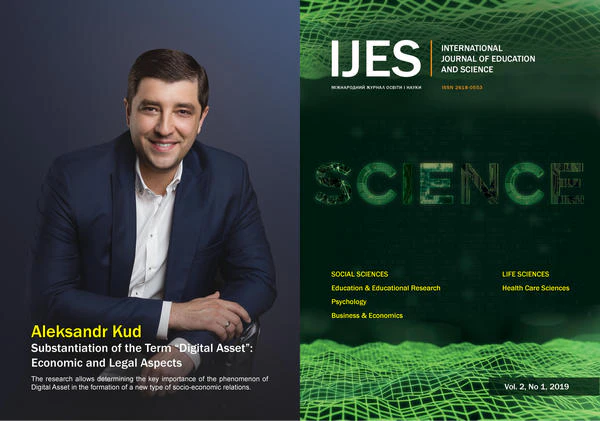
Kud, A. A. (2019). Substantiation of the Term “Digital Asset”: Economic and Legal Aspects. International Journal of Education and Science, 2(1), 41-52. doi:10.26697/ijes.2019.1.06
| 1 National Pedagogical Dragomanov University, Ukraine |
Andrushchenko, V. P., & Bekh, V. P. (2002). (Eds.). Sotsialna robota: Korotkyi entsyklopedychnyi slovnyk [Social work: Brief Encyclopaedic Dictionary]. Kyiv: DTsSSM.
Asher, S. R. (1983). Social competence and peer status: Recent advances and future directions. Child Development, 54(6), 1427–1434. doi:10.2307/1129805
Balakirieva, O. M. (2007). Dyferentsiatsiia zhyttievykh shliakhiv molodoho pokolinnia zalezhno vid faktoriv sotsialnoho seredovyshcha [Differentiation of the life paths of the younger generation depending on the factors of the social environment]. Molod Ukrainy: stan, problemy, shliakhy rozviazannia – Youth of Ukraine: state, problems, ways of solving, 13, 6–9. [in Ukrainian]
Foster, Sh. L., & Ritchey, W. L. (1979). Issues in the assessment of social competence in children. Journal of Applied Behavior Analysis, 12(4), 625–638.
Howe, N., & Strauss, W. (2007). The next 20 years: How customer and workforce attitudes will evolve. Harvard Business Review, 85(7-8), 41–52.
Karvasarskij, B. D. (2014). (Ed.). Klinicheskaja psihologija [Clinical psychology] (5th ed.). SPb.: Piter. [in Russian]
Kostina, V. V. (2018). Verification of the system of preparation of future specialists of the social sphere for the prevention of maladjustment of pupils in various social institutions. International Journal of Science Annals, 1(1-2), 12–20. doi:10.26697/ijsa.2018.1-2.02
Luk’janova, M. I. (2001). Social’naja kompetentnost’ kak komponent upravlencheskoj kul’tury rukovoditelja [Social competence as a component of the managerial managerial culture]. Psihologija innovacionnogo upravlenija social’nymi gruppami i organizacijami – Psychology of innovative management of social groups and organizations, 3, 240–242. [in Russian]
Matviienko, O. V. (2006). Vykhovannia molodshykh shkoliariv: teoriia i tekhnolohiia [Teaching younger students: theory and technology]. Kyiv: VD Stylos. [in Ukrainian]
Melnyk, Yu. (2017). Study of trends of students’ demand for the formation of competences by higher educational institutions. Science and Education, 5, 128–134. doi:10.24195/2414-4665-2017-5-22
Melnyk, Yu. B., & Pypenko, I. S. (2018). Training of future specialists in higher education institutions. International Journal of Science Annals, 1(1-2), 4–11. doi:10.26697/ijsa.2018.1-2.01
Olweus, D. (1996). Bully/victim problems at school: Facts and effective intervention. Reclaiming Children and Youth: Journal of Emotional and Behavioral Problems, 5(1), 15–22.
Podoliak, L. H. (2006). Osnovy vikovoi psykholohii [Fundamentals of age psychology]. Kyiv: Hlavnyk. [in Ukrainian]
Ponimanska, T. I. (1998). Osnovy doshkilnoi pedahohiky [Basics of preschool pedagogy.]. Kyiv: Abrys. [in Ukrainian]
Sapa, A. V. (2014). Pokolenie Z – pokolenie jepohi FGOS [Generation Z – generation of the GEF era]. Innovacionnye proekty i programmy v obrazovanii – Innovative projects and programs in education, 2, 24–30. [in Russian]
Soldatova, H. (2016, August 23). Pokolinnia Z [Generation Z]. UkrMedia. Retrieved from https://ukr.media/science/272956/ [in Ukrainian]
Stelmakh, S. S. (2016). Vikovi aspekty vynyknennia bulinhu sered ditei [Age-related aspects of children’s bullying]. Visnyk Chernihivskoho natsionalnoho pedahohichnoho universytetu: Pedahohichni nauky – Bulletin of the Chernihiv National Pedagogical University: Pedagogical Sciences, 133, 204–207. [in Ukrainian]
Sukhomlynskyi, V. O. (1977). Vybrani tvory [Selected Works]. Kyiv: Radianska shkola. [in Ukrainian]
Tattum, D., & Lane, D. A. (1994). (Eds.). Bullying in schools. Stoke-on-Trent Staffordshire: Trentham Books.
Titov, I. H. (2011). Vstup do psykhofiziolohii [Introduction to psychophysiology]. Kyiv: Akademvydav. [in Ukrainian]
|
Cite this article as:
|
Hubarieva, D. V. (2019). Formed Social Competence as Means to Solve Bullying at Schools. International Journal of Education and Science, 2(1), pp 29-34. doi:10.26697/ijes.2019.1.04
|
1 National Academy of the National Guard of Ukraine, Ukraine
2 Kharkiv Regional Public Organization “Culture of Health”(KRPOCH), Ukraine
3 Scientific Research Institute KRPOCH, Ukraine
|
Background and Aim of Study: The research deals with studying the concept “health culture”. The scientific papers which concern interpretation of the definitions “culture” and “health” as well as their types, have been analysed. The aim of the study: to define the place of the concept “health culture” in the system of categories “culture” and “health”. Materials and Methods: Methodology of the system approach to studying the concept “health culture” has been applied, as well as a set of theoretical research methods such as deduction and induction, analysis and synthesis, abstraction, comparison, generalisation, systematisation, results interpretation. Results: Configuration of various knowledge and opinions on culture and health indicates that there is a close connection and correlation between culture and health. The literature analysis in psychology, medicine, philosophy and pedagogy allows researching scientists’ views on this matter. The place of the concept “health culture” is determined and graphically illustrated in the system of categories “culture” and “health”. The aspect analysis of the concept “health culture” has been applied in order to indicate genus and species relationships of its components, determining correlation between them and grounding their necessity and sufficiency. Conclusions: The methodology of the research has allowed studying the categories “culture” and “health”. Their image has been changing historically during several centuries. The concept “health culture” is presented as one of the elements of the concepts system, that has a close correlation with such concepts as physical, psychological, social and spiritual culture as well as physical, mental (psychological), social and spiritual health, etc. A set of theoretical methods has allowed studying the concept “health culture” and determining within the philosophical area its aspects, such as gnoseological, anthropological, axiological, and ontological. The essential characteristics of the concept “health culture” are ascertained and its place in the system of categories “culture” and “health” is determined.
Amosov, N. M. (2002). Jenciklopedija Amosova. Algoritm zdorov’ja [Amosov Encyclopedia. Health algorithm]. Мoscow: AST. [in Russian]
Andrushchenko, V. P. (Ed.). (2002). Sotsialna robota: korotkyi entsyklopedychnyi slovnyk [Social work: concise encyclopedic dictionary]. Kyiv: DTsSSM. [in Ukrainian]
Anohin, P. K. (1980). Uzlovye voprosy funkcional’noj sistemy [Key issues of the functional system]. Мoscow: Nauka. [in Russian]
Apanasenko, G. L. (1993). Ohrana zdorov’ja zdorovyh: nekotorye problemy teorii i praktiki [Health protection of healthy: some problems of theory and practice]. Valeologija: diagnostika, praktika, sredstva obespechenija zdorov’ja – Valeology: diagnostics, practice, means of ensuring health (pp. 49–60). Saint Petersburg: Nauka. [in Russian]
Bertalanffy, L. V. (1959). Human values in a changing world. In A. H. Maslow (Ed.), New knowledge in human values (pp. 65–74). New York: Harper and Row.
Bulych, E. H., & Muravov, I. V. (1997). Valeolohiia. Teoretychni osnovy valeolohii [Valeology. Theoretical bases of valeology]. Kyiv: IZMN. [in Ukrainian]
Burmenskaja, G. V., & Panfilova, T. V. (Eds.). (1995). Psihoanaliz i kul’tura. Izbrannye trudy Karen Horni i Jeriha Fromma [Psychoanalysis and culture. Selected works of Karen Horney and Erich Fromm]. Мoscow: Jurist. [in Russian]
Eshich, M. B. (1984). Kul’tura v sisteme obshhestva [Culture in the system of society]. Kul’tura v obshhestvennoj sisteme socializma – Culture in the socialist social system (pp. 8–55). Moscow [in Russian]
Florenskij, P. A. (2017). U vodorazdelov mysli (cherty konkretnoj metafiziki) [At the watersheds of thought (features of a particular metaphysics)]. Moscow: Izdatel’stvo Jurajt. [in Russian]
Freud, S. (1924). Psychoanalytische studien an werken der dichtung und kunst [Psychoanalytic studies on works of poetry and art]. Leipzig: Internationaler Psychoanalytischer Verlag. [in German]
Fromm, E. (1930). Zur entstehung des Christusdogmas [On the origin of the Christ dogma]. Vienna: Psychoanalytischer Verlag. [in German]
Golovin, S. Ju. (1998). Slovar’ prakticheskogo psihologa [Dictionary of practical psychologist]. Minsk: Harvest. [in Russian]
Gorashchuk, V. P. (2003). Formirovanie kul’tury zdorov’ia shkol’nikov (teoriia i praktika) [Formation of health culture of schoolchildren (theory and practice)]. Lugansk: Al’ma-mater. [in Russian]
Gricanov, A. A. (Ed.). (2003). Novejshij filosofskij slovar’ [Newest Philosophical Dictionary] (3rd ed.). Minsk: Knizhnyj Dom. [in Russian]
Gurevich, P. S. (2001). Filosofija kul’tury [Culture philosophy]. Мoscow: ID Nota Bene. [in Russian]
Horney, K. (1994). The neurotic personality of our time. New-York: W. W. Norton & Company.
Hrynova, V. M. (1998). Formuvannia pedahohichnoi kultury maibutnoho vchytelia (teoretychnyi ta metodychnyi aspekty) [Formation of the pedagogical culture of the future teacher (theoretical and methodical aspects)]. Kharkiv: Osnova. [in Ukrainian]
Kal’ju, P. I. (1998). Sushhnostnaja harakteristika ponjatija “zdorov’ja” i nekotorye voprosy perestrojki zdravoohranenija: obzornaja informacija [The essential characteristics of the concept of “health” and some issues of health care restructuring: an overview]. Мoscow. [in Russian]
Kostenko, O. M. (2010, December 8). Sotsialna kultura hromadian – osnova prohresyvnoi polityky [The social culture of citizens is the basis of progressive politics]. Politdumka. Retrieved from http://www.politdumka.kiev.ua [in Ukrainian]
Kroeber, A., & Kluckhohn, C. (1952). Culture. A critical review of concept and definitions. Cambridge, Massachusetts: The Museum.
Kryvosheieva, H. (2001). Kultura zdorovia osobystosti yak sotsialno-pedahohichna problema [Culture of personality health as a socio-pedagogical problem]. Shliakh osvity – Path of Education, 1, 35–37. [in Ukrainian]
Lozova, V. I., & Trotsko, H. V. (1997). Teoretychni osnovy vykhovannia i navchannia [Theoretical foundations of education and training]. Kharkiv. [in Ukrainian]
Maslow, A. H. (1961). Health as transcendence of environment. Journal of Humanistic Psychology, 1(1), 1–7. doi:10.1177/002216786100100102
Melnyk, Yu. B. (2005, April). Fenomen “kuljtura zdorov’ja” (metodologhichnyj ta metodychnyj aspekty) [The phenomenon of “health culture” (methodological and methodological aspects)]. In G. L. Apanasenko (Ed.), World Ethical Forum “Ethics and Humanism” (pp. 177–179). Alushta, Crimea. [in Ukrainian]
Melnyk, Yu. B. (2002). Formuvannia kultury zdorovia uchniv pochatkovoi shkoly [Formation of the health culture of primary school pupils]. Pedahohika, psykholohiia ta medyko-biolohichni problemy fizychnoho vykhovannia i sportu – Pedagogics, psychology, medical-biological problems of physical training and sports, 23, 37–49. [in Ukrainian]
Melnyk, Yu. B. (2004). Osoblivosti formuvannia kul’turi zdorov’ia: model’ kul’turi zdorov’ia osobistosti uchnia [Features of the formation of a health culture: a model of the health culture of the learner’s personality]. Pedahohika, psykholohiia ta medyko-biolohichni problemy fizychnoho vykhovannia i sportu – Pedagogics, psychology, medical-biological problems of physical training and sports, 11, 37–46. [in Ukrainian]
Melnyk, Yu. B., & Sviachena, S. M. (2002). Orhanizatsiia zdorovoho sposobu zhyttia v shkoli ta formuvannia kultury zdorovia uchniv pochatkovykh klasiv [Organize a healthy lifestyle in school and form a health culture for primary school pupils]. Kharkiv: KhDPU. [in Ukrainian]
Melnyk, Yu. B. (2007). Teoretychne obgruntuvannia sotsialno-pedahohichnoi tekhnolohii formuvannia kultury zdorovia v pochatkovii shkoli [Theoretical substantiation of social-pedagogical technology of forming a health culture in elementary school]. Visnyk Kharkivskoi derzhavnoi akademii kultury – Bulletin of Kharkiv State Academy of Culture, 21, 234–241. [in Ukrainian]
Melnyk, Yu. (2017). Monitoring of formation health culture of schoolchildren. Journal of Physical Education and Sport, 17(4), 2073–2079. doi:10.7752/jpes.2017.s4210
Melnyk, Yu., & Stadnik, A. (2018). Mental health of a personality: diagnostics and prevention of mental disorders. International Journal of Education and Science, 1(3-4), 50. doi:10.26697/ijes.2018.3-4.37
Melnyk, Yu. (2019). The influence of educational, physical cultural and healthy work on the formation of the health culture of master’s students. Journal of Physical Education and Sport, 19(1). 219–226. doi:10.7752/jpes.2019.s1033
Orzhekhovska, V. M. (1997). Zdorovyi sposib zhyttia yak priorytetna tsinnist u vykhovanni pidlitkiv [A healthy lifestyle as a priority value in bringing up teens]. In O. V. Sukhomlynska (Ed.), Tsinnosti osvity i vykhovannia – Values of education and upbringing (pp. 188–191). Кyiv. [in Ukrainian]
Ovcharova, R. V. (2003). Prakticheskaja psihologija obrazovanija [Practical psychology of education]. Moscow: IC “Akademija”. [in Russian]
Polishhuk, V. I. (1993). Mirovaja i otechestvennaja kul’tura [World and domestic culture]. Yekaterinburg: Izdatel’stvo Ural’skogo universiteta. [in Russian]
Postovyi, V. H. (Ed.). (2002). Pedahohichnyi slovnyk dlia molodykh batkiv [Pedagogical dictionary for young parents]. Kyiv: DTsSSM. [in Ukrainian]
Rerih, N. (1992). Derzhava sveta. Svjashhennyj dozor [Power of light. Sacred patrol]. Riga: Vieda. [in Russian]
Shakhnenko, V. I. (2002). Zasoby zberezhennia i zmitsnennia zdorovia ditei shestyrichnoho viku v navchalno-vykhovnomu protsesi [Means of preservation and strengthening of health of children of six years of age in educational process]. Dzherelo pedahohichnoi maisternosti – The source of pedagogical skill, 1, 12–19. [in Ukrainian]
Shynkaruk, V. I. (Ed.). (1986). Filosofskyi slovnyk [Philosophical Dictionary] (2nd ed.). Кyiv: Holovna red. ukr. rad. entsyklopedii. [in Ukrainian]
Skumin, V. A., & Bobina, L. A. (1994). Propedevtika kul’tury zdorov’ja [Propaedeutics health culture]. Novocheboksarsk: Teros. [in Russian]
Skumin, V. A. (1995). Kul’tura zdorov’ja – fundamental’naja nauka o cheloveke [Health culture is the fundamental science of man.]. Novocheboksarsk: Teros. [in Russian]
Sokolov, Je. V. (1972). Kul’tura i lichnost’ [Culture and personality]. Leningrad: Nauka. [in Russian]
Stepanenkova, Je. Ja. (2001). Teorija i metodika fizicheskogo vospitanija i razvitija rebenka [Theory and methods of physical education and child development]. Moscow: IC “Akademija”. [in Russian]
Stepin, V. S. (2003). Novejshij filosofskij slovar’ [Newest Philosophical Dictionary] (3rd ed.). In A. A. Gricanov (Ed.). Minsk: Knizhnyj Dom. [in Russian]
Svyrydenko, S. O. (2000). Formuvannia kultury zdorovia dytyny v simi yak chynnyk sotsialnoi kompetentnosti [Formation of the health culture of the child in the family as a factor in social competence]. In I. Yermakov (Ed.), Kroky do kompetentnosti ta intehratsii v suspilstvo – Steps to competence and integration into society (pp. 135–138). Kyiv: Kontekst. [in Ukrainian]
Torohova, E. I. (1999). Valeologija: slovar’ [Valeology: Dictionary]. Moscow: Flinta: Nauka. [in Russian]
Treshheva, O. L. (2003, May). Kul’tura zdorov’ja lichnosti (teoreticheskaja model’) [Personal health culture (theoretical model).]. VІІ International Scientific Congress “Sovremennyj olimpijskij sport i sport dlja vseh” – VІІ International Scientific Congress “Modern Olympic sport and sport for all” (pp. 177–178). Moscow: Sport Akadem Press. [in Russian]
Volkov, Ju. G., & Polikarpov, V. S. (1999). Chelovek: Jenciklopedicheskij slovar’ [Person: Encyclopedic Dictionary]. Moscow: Gardariki. [in Russian]
Zhelezovskaja, G. I., & Eremina, S. V. (1999). Principy formirovanija didakticheskih terminov [Principles of the formation of didactic terms]. Pedagogika – Pedagogy, 5, 18–22. [in Russian]
|
Cite this article as:
|
|
Melnyk, Yu. B., & Pypenko, I. S. (2019). Concept “Health Culture” in System of Categories “Culture” and “Health”. International Journal of Education and Science, 2(1), 53-64. doi:10.26697/ijes.2019.1.07
|
- Issimova A. E. Methods of Psychoanalysis in the Psychological Support of Families of Military Personnel Participating in Peacekeeping Activities
- Yevtushenko Yu. O. Deontological Culture of Teachers of Medical Higher Educational Establishments: Preliminary Remarks
- Bielikova O. V. , Dytiuk S. O., Krech T. V. Special Moments in Ukrainian and Foreign Students Perception of a Lecturer’s Personality
- Volume 2 №2 2019 (IJES)