Issimova A. E.1
|
1 National Defense University named after the First President of the Republic of Kazakhstan – Yelbasy, Kazakhstan
|
Background and Aim of Study: Psychoanalysis is one of the forms of the psychotherapy, aimed to help clients to understand their unconscious feelings that is directly effect to their current behavior, thought and emotions. The aim of the study: to substantiate ways of using methods of psychoanalysis in the psychological support of families of military personnel participating in peacekeeping activities. Materials and Methods: In the study, the following general scientific methods has been used: analysis, synthesis, comparison, generalization. Participants – mothers/wives of military personnel who is taking part in peacekeeping mission is one of the objects that have necessity to psychologically support to reduce their stress, their perception to stressors, its social-psychological implications and focusing on creating possible mechanisms of decreasing their stress level by making social identification as central through psychoanalytical approach. Results: Although the peacekeeping mission has effected positively to military personnel, studies have found that there are negative effects from the operations to military personnel’s family members. Deeply analyzing these influences, the study shows the importance of psychological support for family members in all stages of military deployment, in particular, psychological support is a crucial for individuals who have a feeling of anxiety and sadness due to separation and loss. That means, separation and loss are significant influential variables, which related to their well-being considerably. Accentuating the psychoanalytic approach and using of Fairbairn’s psychoanalytic interview about an attachment may not only an opportunity to understand the client’s issue, but it is an active social interaction that is related to stress buffering. It was proved, Fairbairn’s psychoanalytic model is one of the possibilities to specify which ego structures are overdeveloped and which are underdeveloped, because of the type of family backgrounds. Conclusions: Despite the controversial views about the study of psychoanalysis as a science, psychoanalysis technique based social psychological integrative study could bring new effects on the development of psychology.

Bowlby, J. (1980). Attachment and loss: Loss sadness and depression (Vol. 3). New York: Basic Books.
Bowlby, J. (1960). Separation anxiety. International Journal of Psychoanalysis, 41, 89–113.
Celani, D. P. (2007). A structural analysis of the obsessional character: A Fairbairnian perspective. The American Journal of Psychoanalysis, 67(2), 119–140. doi:10.1057/palgrave.ajp.3350015
Cruwys, T., Haslam, S. A., Dingle, G. A., Jetten, J., Hornsey, M. J., Chong, D. E. M., & Oei, T. P. (2014). Feeling connected again: Interventions that increase social identification reduce depression symptoms in community and clinical settings. Journal of Affective Disorders, 159, 139–146. doi:10.1016/j.jad.2014.02.019
Gewirtz, A. H., Erbes, Ch. R., Polusny, M. A., Forgatch, M. S., & DeGarmo, D. S. (2011). Helping military families through the deployment process: Strategies to support parenting. Professional Psychology: Research & Practice, 42, 56–62. doi:10.1037/a0022345
Haslam, A., Jetten, J., Postmes, T., & Haslam, C. (2009). Social identity, health and well-being: An emerging agenda for applied psychology. Journal of Applied Psychology, 58(1), 1–23. doi:10.1111/j.1464-0597
John, H., & Newby, D. S. W. (2005). Positive and negative consequences of a military deployment. Military Medicine, 170(10), 815–819.
Kudijarova, A. (2005). Metody i tehniki psihoanaliza [Methods and techniques of psychoanalysis]. Almaty: Daryn. [in Russian]
Lambert, M. J. (2013). Bergin and Garfield’s handbook of psychotherapy and behavior change (6th ed.). New York: Wiley.
Mansfield, A. J., Kaufman, J. S., Marshal, S. W., Gayness, B. N., Morrissey, J. P., & Engel, C. C. (2010). Deployment and the use of mental health services among U. S. Army wives. New England Journal of Medicine, 362, 101–109.
Melnyk, Yu. B. (2018). Psykholohichne zabezpechennia i suprovid viiskovosluzhbovtsiv yak zasoby profilaktyky ta podolannia posttravmatychnykh stresovykh rozladiv [Psychological support and support of military-men as means of prevention and overcoming post-traumatic stress disorder]. Posttraumatic Stress Disorder: adults, children and families in a war situation, 2, 469–480. [in Ukrainian]
Melnyk, Yu. B. (2012). Teoretychni ta metodolohichni zasady medychno-psykholohichnoho suprovodu [Theoretical and methodological principles of medical and psychological support]. In I. F. Prokopenko (Ed.), Psykholoho-pedahohichni problemy v osvitnomu protsesi – Psychological-pedagogical problems in educational process (pp. 168–174). Kharkiv: KhNPU, KhOHOKZ. doi:10.26697/9789669726018.2012.168 [in Ukrainian]
Rector, N., & Roger, D. (1997). The stress buffering effects of self-esteem. Personality and Individual Difference, 23(5), 799–808. doi:10.1016/S0191-8869(97)00095-0
Pincus, S. Y., Youse, R., Christension, J., & Adler, L. E. (2001). The emotional cycle of deployment: A military family perspective. U. S. Army Medical Department Journal, 2(5), 15–23.
Rosse, J., Boss, R., & Johnson, A. (1991). Conceptualizing the role of self-esteem in the burnout process. Group and Organizational Studies, 16(4), 428–481. doi:10.1177/105960119101600406
Steinar, K. (2001). The psychoanalytic interview as inspiration for qualitative research. Journal of Qualitative Research, 29–83.
Weitkamp, K., Daniels, J. K., Baumeister‐Duru, A., Wulf, A., Romer, G., & Wiegand‐Grefe, S. (2018). Effectiveness trial of psychoanalytic psychotherapy for children and adolescents with severe anxiety symptoms in a naturalistic treatment setting. British Journal of Psychotherapy, 34(2), 300–318. doi:10.1111/bjp.12363
Issimova Ainash Esengeldievna – http://orcid.org/0000-0003-4111-1164;
|
Cite this article as:
|
Issimova, A. E. (2019). Methods of Psychoanalysis in the Psychological Support of Families of Military Personnel Participating in Peacekeeping Activities. International Journal of Education and Science, 2(1), 35–40. doi:10.26697/ijes.2019.1.05
Deontological Culture of Teachers of Medical Higher Educational Establishments: Preliminary Remarks
Yevtushenko Yu. O.1
|
1 Luhansk State Medical University, Ukraine
|
Background and Aim of Study: The article deals with the analysis of the problem of formation of deontological culture of teachers of medical higher educational establishments. The aim of the study: to outline the key points of the problem of the formation of deontological culture of teachers of medical higher educational institutions. Materials and Methods: A number of theoretical methods of analysis were employed in order to reveal the essence of the analyzed phenomenon, namely analytical review of scientific literature of Ukrainian and foreign scholars which deals with the problem of formation of deontological culture of teachers of higher educational institutions, theoretical analysis of the content and structure of the phenomenon in question, etc. Results: The author insists that one of the most important components in the professional activity of teachers of medical higher educational establishments, apart from purely medical knowledge, skills and habits, is connected with their pedagogical competence. Thus, there appears a problem of formation of pedagogical competence of teachers of medical educational institutions in general and their deontological pedagogical culture in particular. It goes about the necessity to form deontological culture of teachers of medical higher educational establishments which lies in the medical and pedagogical space. Conclusions: The author arrives at the conclusion that deontological culture in modern social and cultural conditions acts as an important social and personal resource of humanization of the system of education and a teacher’s professional activity. The problem-thematic space of the analysis of deontological culture of teachers of medical higher educational establishments is open for studying and needs further theoretical and applied solutions aimed at searching new technological mechanisms of the development in conditions of a multi-aspect pedagogical environment and intensification of the processes in the sphere of education.
deontological culture, teachers of medical higher educational establishments, moral and ethical principles, content and structure of deontological culture, educational process.
Atamanchuk, G. V. (2006). Teorija gosudarstvennogo upravlenija [Theory of state governance: a course of lectures]. Moscow: Omega-L. [in Russian]
Bykova, S. S. (2012). Formirovanie deontologicheskoj kompetentnosti u budushhih pedagogov v sisteme professional’nogo obrazovanija [Formation of deontological competence of future pedagogues in the system of professional education]. Vestnik Vjatskogo Gosudarstvennogo Gumanitarnogo Universiteta – Bulletin of Vyatka State Humanitarian University, 3(4), 37–41. [in Russian]
Çipi, B., & Meksi, S. (2013). Medical ethics. Tirana: Klean.
Filatova, I. A. (2015). Deontologicheskaja kompetentnost’ budushhih pedagogov-defektologov [Deontological competence of future pedagogues-speech philologists]. Special’noe obrazovanie – Special education, 2, 105–115. [in Russian]
Karahanova, G. A. (2007) Formirovanie deontologicheskoj kul’tury uchitelja v sisteme nepreryvnogo professional’nogo obrazovanija [Formation of deontological culture of a teacher in the system of a continuous professional education] (Doctoral dissertation, Russian State Social University, Moscow, Russia). [in Russian]
Kertaeva, K. M. (2002). Osnovy pedagogicheskoj deontologii [Foundations of pedagogical deontology]. Almaty. [in Russian]
Kostomarova, E. V. (2014). Deontologicheskaja kompetentnost’ studenta-medika kak faktor uspeshnost’ professional’noj dejatel’nosti vracha [Deontological competence of a medical student as a factor of successfulness of professional activity of a doctor]. Izvestija Volgogradskogo Gosudarstvennogo Pedagogicheskogo Universiteta – Bulletin of Volgograd State Pedagogical University, 4(89), 134–138. [in Russian]
Kravtsov, V. O. (2011). Deontolohichna kultura yak skladova metodolohichnoi kultury maibutnoho vchytelia [Deontological culture as a component of methodological culture of a future teacher]. Naukovi zapysky KDPU. Pedahohichni nauky – Scientific Bulletin of KDPU. Pedagogical Sciences, 101, 21–30. [in Ukrainian]
Makarenko, A. S. (1951). Sochinenija [Collection of works]. Moscow. [in Russian]
Mandal, J., Ponnambath, D. K., & Parija, S. C. (2016). Utilitarian and deontological ethics in medicine. Tropical Parasitology, 6(1), 5–7. doi:10.4103/2229-5070.175024
Melnyk, Yu. (2017). Study of trends of students’ demand for the formation of competences by higher educational institutions. Science and Education, 5, 128–134. doi:10.24195/2414-4665-2017-5-22
Melnyk, Yu. B., & Pypenko, I. S. (2018). Training of future specialists in higher education institutions. International Journal of Science Annals, 1(1-2), 4–11. doi:10.26697/ijsa.2018.1-2.01
Pestalozzi, I. G. (1961-1965). Izbrannye pedagogicheskie proizvedenija [Selected pedagogical works]. Moscow. [in Russian]
Ramos, F. (2011). Professional deontology in teacher training. Report on a training experience. Publicaciones. Facultad de Educación y Humanidades Campus de Melilla, 41, 9–31.
Rohr, J. (2009). French deontology. Public Administration Review, 69(1), 143–145. doi:10.1111/j.1540- 6210.2008.01952.x
Romanyshyna, L. M., & Telychko, N. V. (2015). Problema deontolohii u formuvanni profesiino-etychnoi kultury yak skladovoi zahalnoi kultury fakhivtsia [Problem of deontology in professional and ethical culture as a component of a general culture of a specialist]. Visnyk Natsionalnoi akademii Derzhavnoi prykordonnoi sluzhby Ukrainy – Bulletin of the National Academy of Border Guards Service, 2. Retrieved from http://nbuv.gov.ua/UJRN/Vnadps_2015_2_17 [in Ukrainian]
Rosić, V. (2011). Teacher’s deontology. The Basis of the Pedagogical Ethics, 44, 142–149.
Starov, M. I. (2011). Otvetstvennost’ kak vazhnaja psihologo-pedagogicheskaja sostavljajushhaja duhovno-nravstvennogo razvitija lichnosti studenta [Responsibility as an important psychological and pedagogical component of spiritual and moral development of student’s personality]. Vestnik Tambovskogo universiteta. Gumanitarnye nauki – Bulletin of Tambov University. Humanitarian Sciences, 104(12-2), 593–596. [in Russian]
Ushinskiy, K. D. (1974). Izbrannye pedagogicheskie sochinenija [Selected pedagogical works]. Moscow: Pedagogika. [in Russian]
Vasylieva, M. P. (2004). Teoretychni osnovy deontolohichnoi pidhotovky pedahoha [Theoretical foundations of deontological training of a pedagogue] (Abstract of Doctoral dissertation, H. S. Skovoroda Kharkiv National Pedagogical University, Kharkіv, Ukraine). [in Ukrainian]
Yevtushenko, Yu. O. (2017). Formuvannia deontolohichnoi kultury maibutnikh likariv u navchalno-vykhovnomu protsesi medychnoho VNZ [Formation of deontological culture of future doctors in the educational process of a medical higher educational establishment] (Doctoral dissertation, Taras Shevchenko Luhansk National University, Starobilsk, Ukraine). [in Ukrainian]
Zhukovskiy, V. P., & Ilkovskaya, I. M. (2013). Deontologicheskij aspekt pedagogicheskoj dejatel’nosti: novye orientiry rolevogo povedenija uchitelja [Deontological aspect of pedagogical activity: new guidelines of role-playing behavior of a teacher]. Aktual’nye problemy vospitanija detej i molodezhi v sovremennoj Rossii – Topical problems of education of children and youth in modern Russia (pp. 33–38). Saratov. [in Russian]
Zhukovskiy, V. P. (2015). Transsituativnaja ustojchivost’ povedenija pedagoga v sovremennom obrazovatel’nom prostranstve: teoretiko-metodologicheskie osnovanija razvitija [Trans-situational stability of behavior of a pedagogue in modern educational space: theoretical and methodological foundations of development]. Edinaja obrazovatel’naja sreda kak faktor socializacii obuchajushhihsja: Ch. 1. – United educational environment as a factor of socialization of students: P. 1 (pp. 173–178). Saratov: SOIRO. [in Russian]
Yevtushenko Yuliia Oleksandrivna – https://orcid.org/0000-0002-7315-3337;
|
Cite this article as:
|
Yevtushenko, Yu. O. (2019). Deontological Culture of Teachers of Medical Higher Educational Establishments: Preliminary Remarks. International Journal of Education and Science, 2(1), 22–28. doi:10.26697/ijes.2019.1.03
Special Moments in Ukrainian and Foreign Students Perception of a Lecturer’s Personality
Bielikova O. V. 1, Dytiuk S. O.1, Krech T. V.1
|
1 Kharkiv National University of Civil Engineering and Architecture, Ukraine
|
Background and Aim of Study: In process of introduction of new requirements and standards of teaching, significant transformations of lecturer and student’s interaction take place. A system of role expectation as to lecturer’s main qualities changes. The aim of the study: to research and justify of theoretical basements of diagnostics of results of forming professional competencies of pedagogues in universities. Materials and Methods: For analyzing special features of language training lecturer’s perception that are important for students of our university we conducted a survey: “A lecturer in foreign students’ eyes”. Students of faculty of construction and faculty of architecture of Kharkiv National University of Civil Engineering and Architecture took part in it. This survey been held in several stages. On stage one foreign students of elder grades had to finish the sentence: “Modern university lecturer should be …” by using their own thoughts. After processing the results of our survey, we made a list of lecturer’s features that are important for students. Students of younger grades had to rank the features from the list we got. Our research has been held for 10 years. We have been using methods of covert surveillance and partial distributive analysis of researched material. Results: For Ukrainian and foreign students image of their lecturer consists of many subjective factors of perception and includes several groups of qualities: personal qualities, that characterize lecturer as a person; professional qualities, that characterize lecturer’s professional level; and social qualities, that characterize lecturer’s communicative skills and his ability to “stay in touch” with students. Conclusions: Effectiveness and optimization of Ukrainian and foreign students’ teaching process depends both on lecturer’s pedagogical masterpiece and on his character.
lecturer’s professional competence, Ukrainian and foreign students, universities of technical profile, competence approach, professional graphic monitoring.
Andreeva, G. M. (2014). Socialnaja psihologija [Social psychology] (5th ed.). Moscow: Aspekt Press. [in Russian]
Bakhtin, M. M. (1986). Problema teksta v lingvistike, filologii i drugikh gumanitarnykh naukakh [Problem of text in linguistics, philology and other human sciences]. In M. M. Bakhtin (Ed.), Jestetika slovesnogo tvorchestva – Aesthetics of verbal creativity (pp. 297–325). Moscow. [in Russian]
Jakobson, R. (1965). Itogi Devjatogo kongressa lingvistov [The results of the Ninth congress of linguists]. Novoe v lingvistike – New in linguistics, 4, 361. [in Russian]
Karaulov, Yu. N. (1987). Russkij yazyk i yazykovaja lichnost [Russian language and language personality]. Moscow: Science. [in Russian]
Kichuk, N. V. (Ed.) (2007). Kompetentnost samorazvitija specialista: pedagogicheskie osnovy formirovanija v vysshej shkole [Competence of the specialist’s self-development: the pedagogical foundations of the formation in higher education]. Izmail: IGGU. [in Russian]
Kompetentnostnyj podhod v sovremennom obrazovanii: mirovoj opyt i ukrainskie perspektivy [Competence approach in modern education: international experience and Ukrainian perspectives]. (2004). In O. V. Ovcharuk (Ed.), Biblioteka po obrazovatel’noj politike – Library for educational policy. Moscow: “K.I.S”. [in Russian]
Melnyk, Yu. (2017). Study of trends of students’ demand for the formation of competences by higher educational institutions. Science and Education, 5, 128–134. doi:10.24195/2414-4665-2017-5-22
Melnyk, Yu. B., & Pypenko, I. S. (2018). Training of future specialists in higher education institutions. International Journal of Science Annals, 1(1-2), 4–11. doi:10.26697/ijsa.2018.1-2.01
Metodyka navchannia ukrainskoi movy (2016, February 24). [Methodology of teaching the Ukrainian language]. StudFiles. Retrieved from https://studfiles.net/preview/5537864/page:13/ [in Ukrainian]Muras, A. (2007). Vykladannia ukrainskoi movy yak inozemnoi v Universyteti imeni Adama Mitskevycha v Poznani [Teaching Ukrainian as a Foreign Language at the Adam Mickiewicz University in Poznan]. Teoriia i praktyka vykladannia ukrainskoi movy yak inozemnoi – Theory and Practice of Teaching Ukrainian as a Foreign Language, 2, 258–261. [in Ukrainian]Novikov, L. A. (1970). Russkyi yazyk kak ynostrannyi y osnovnye voprosy eho opysanyia [Russian as a foreign language and the main questions of its description]. Russkyi yazyk za rubezhom – Russian language abroad, 4(16). [in Russian]
Ortynskyi, V. L. (2017). Pedahohika vyshchoi shkoly [High school pedagogy]. Kyiv: Center for Literature Studies. [in Ukrainian]
Panina, S. V., & Makarenko, T. A. (2017). Samoopredeleniye i professionalnaya oriyentatsiya uchashchikhsya [Self-determination and professional orientation of students] (3rd ed.). Moscow: Yurayt. [in Russian]
Podlasiy, I. P. (2015). Pedagogika [The pedagogy]. Moscow: VLADOS. [in Russian]
Rudneva, T. I., Astakhova, S. V., & Lapshova, E. S. (2008). Professional’naya podhotovka spetsialistov humanitarnoho profilia [Professional training of specialists of humanitarian profile] [Monograph]. Samara: Samara University. [in Russian]
Salistra, I. D. (1966). Ocherki metodov obucheniya inostrannym yazykam [Essays on methods of teaching foreign languages]. Moscow: Vysshaja shkola. [in Russian]Shubin, Je. P. (1972). Pozitivnye i negativnye aspekty vliyaniya pervogo yazyka na ovladenie vtorym na razlichnyh urovnyah yazykovoj sistemy [Positive and negative aspects of the influence of the speaker language on mastering the second on different levels of the language system]. Inostrannye yazyki v shkole, 5, 27–32. [in Russian]
Slastenin, V. A., Isayev, I. F., & Shiyanov, Ye. N. (2015). Pedagogika: [The pedagogy]. Moscow: School Press. [in Russian]
Tkachova, T. M. (2015). Rol’ lichnosti v obespechenii kachestva prfessional'noy podgotovki vypusknikov vuza [The role of the individual in ensuring the quality of vocational training of graduates of the university]. Moscow: MADI. [in Russian]
Vasil’ev, A. D. (2015). Slovo v rossijskom teleefire [The word on Russian television]. Moscow: Nauka. [in Russian]
Vereshhagin, E. M., & Kostomarov, V. G. (1976). Jazyk i kul’tura: Lingvostranovedenie. [Language and culture: Linguistic studies]. Moscow: Nauka. [in Russian]
Volkogonova, O. D., & Chaplygin, A. K. (2005). Orientirujas’ na Bolonskij protsess: opyt transformatsii vysshego obrazovaniya v Rossii i Ukraine [Focusing on the Bologna process: the experience of the transformation of higher education in Russia and Ukraine]. Suchasni tekhnolohii pidhotovky fakhivtsiv v umovakh podalshoho rozvytku vyshchoi osvity Ukrainy – Modern technologies of training specialists in conditions of further development of higher education in Ukraine (pp. 192-194). Kharkiv: HNADU. [in Russian]
Zimnyaya, I. A. (2010). Pedagogicheskaya psikhologiya [Pedagogical psychology] (3rd ed.). Moscow: MPSI; Voronezh: NPO “MODJeK”. [in Russian]
Bielikova Olena Vitaliivna – http://orcid.org/0000-0001-8580-112X;
Dytiuk Svitlana Oleksiivna – http://orcid.org/0000-0001-8580-112X;
Krech Tetiana Vasylivna – http://orcid.org/0000-0003-0865-1716;
|
Cite this article as:
|
Bielikova, O. V., Dytiuk, S. O., & Krech, T. V. (2019). Special Moments in Ukrainian and Foreign Students Perception of a Lecturer’s Personality. International Journal of Education and Science, 2(1), 14–21. doi:10.26697/ijes.2019.1.02
Volume 2 №2 2019
|
CONTENTS
|
PAGE
|
DOWNLOAD
|
|---|---|---|
|
EDITORIAL
|
11
|
 |
|
Message from Editor in-Chief |
12 | |
|
SOCIAL SCIENCES |
13 |
|
|
Education & Educational Research |
||
|
Avramenko K. B. The Implementation of Continuity in the Formation of Mathematical Literacy of Primary School Teachers (in Ukrainian) |
14 |
|
|
Blahun S. S. Methodology for Teaching Pharmaceutical Terminology, Botanical and Chemical Nomenclature Using Interactive Teaching Technologies |
15 |
|
|
Dubova L. V. Psychology and Pedagogical Conditions of Formation of Readiness of Future Teacher of Chemistry for Creative Self-Realization in Professional Activity (in Ukrainian) |
16 |
|
|
Ilkiv A. V., Krynytska О. І. Extralinguistic Means of Intercultural Communication at Classes in Ukrainian as a Foreign Language (in Ukrainian) |
17 |
|
|
Кhlon A. M. Legal Consciousness of a Young Specialist as a Problem of Becoming a Modern Expert |
18 |
|
|
Khomenko L. M. Non-Curricular Foreign Language Training of Students of Agricultural Institutes of Higher Education of Ukraine in the Second Half of the XX Century (in Ukrainian) |
19 |
|
|
Kliuchka S. I., Starovoytenko N. V. Ecological Competence as an Active Position of Personality |
20 |
|
|
Korniychuk O. P., Nemchenko O. O., Melnyk O. V. Research of Influence of Informatively-Communication Technologies is in Structural Subdivision of Higher Educational Establishment |
21 |
|
|
Kozma A. A. Advantages of Using Semi-Empirical Methods in Teaching Students at the Faculty of Chemistry of Uzhhorod National University |
22 |
|
|
Lazareva O. Ya., Kovtun O. O. Experience of Applying Computer-Aided Testing in English Classes |
23 |
|
|
Luzan P. G., Pashchenko T. M., Mosya I. А. Contents and Structure of Preparedness of Pedagogical Workers to Standardization of Preparation for Young Specialists (in Ukrainian) |
24 |
|
|
Marchuk L. S. Current State and Trends of Pedagogical Activity Development |
25 |
|
|
Markova Ie. Yu., Venig N. M., Shpigotsky Ie. V. The Role of Andragogics in the System of Uninterrupted Professional Education |
26 |
|
|
Mashiko K. S. Trends and Motives of Educational Migration from Ukraine to the Countries of the European Union (in Ukrainian) |
27 |
|
|
Nosivets D. S. Methodological Provider for Students of Foreigners in the Modern Educational Space |
28 |
|
|
Oleksyuk O. Ye. Some Methods of the Leader-Patriot Personality Formation Among the Students in the Study of General Psychology |
29 |
|
|
Opolska A. V. Specifics of Using of Innovative Technologies During the Qualification Improvement of Teachers and Education Managers (in Ukrainian) |
30 |
|
|
Pashchenko A. A. Formation of Professional and Personal Qualities of the Future Specialist (in Ukrainian) |
31 |
|
|
Polhun K. V. Assessment of the Results of Teacher Training by Means of Moodle (in Ukrainian) |
32 |
|
|
Ptakhina O. М. Development of Professional Mobility as Component of Professional Competence in Postgraduate Education System |
33 |
|
|
Shvets T. A., Shvets N. V., Shvets O. V. Translations Comparison as a Means of Future Translators’ Professional Competence Formation (in Ukrainian) |
34 |
|
|
Synevych I. S. The Structure of Quasi-Professional Experience (in Ukrainian) |
35 |
|
| Tokuieva N. V., Mikos I. M., Petrenko L. F.
Communicative Aspect of Teaching Ukrainian as a Foreign Language in the Early Stage (in Ukrainian) |
36 |
|
|
Tsurkan M. V. Ways of Forming a Speech Etiquette of Professional Communication of a Foreign Student-Physician (in Ukrainian) |
37 |
|
|
Yurko N. A., Romanchuk O. V., Protsenko U. M. Developmental Assets in Physical Education |
38 | |
|
Yurko N. A., Styfanyshyn I. M., Romanchuk O. V. English and Physical Education: The Mutually Beneficial Integration |
39 | |
|
Zaichko A. S. The Pedagogical Conditions of Successful Implementation the Model to Future Pedagoges’ Preparation in Primary Schools to Using Means of Pedagogical Bibliotherapy in Professional Activities (in Ukrainian) |
40 | |
|
Psychology
|
41 |
|
|
Fedorchuk O. I. Responsibility in a Future Teacher Value Orientations Complex (in Ukrainian) |
42 |
|
|
Honchar Yu. A. Main Psychological Factors of Life Perspective Formation in the Context of Medical-Social Expertise and Rehabilitation for Young People with the Status of Disabled Child |
43 |
|
|
Hubarieva D. V. Formation of Social Competence to Prevent Bullying in Schools |
44 |
|
|
Ibrahim Z. E. Teachers Attitudes Toward Special Need Students and Teaching Sittings Readiness in Egypt |
45 |
|
|
Kashubiak I. O. Critical Thinking as Philosophical and Psychological Category |
46 |
|
|
Kobzieva Iu. A. Imagination as a Component of Ludic Competence |
47 |
|
|
Korniyaka O. M. Psychological Support for University Lecturers’ Professional Self-Fulfilment |
48 |
|
| Kostyuchenko E. V.
Metaforization as a Psychological Resource of the Potential for the Future Specialist (in Ukrainian) |
49 |
|
| Plachynda T. S.
Psychophysiological Readiness of Future Pilots in Civil Aviation and its Formation (in Ukrainian) |
50 |
|
| Polishchuk V. M.
Crisis Behavioural Symptoms Set in Person’s Age Development |
51 |
|
| Tanasiychuk E. N. Archetypes as a Factor of Personality’s Professionalization |
52 |
|
|
Business & Economics
|
53 |
|
|
Lysyuk V. S. The Institution of Trust as an Integral Institutional Factor of the Creative Economy (in Ukrainian) |
54 |
|
|
Melnyk Yu. B. Cryptocurrency Possibilities in Target Financing of Public Social Payments |
55 |
|
|
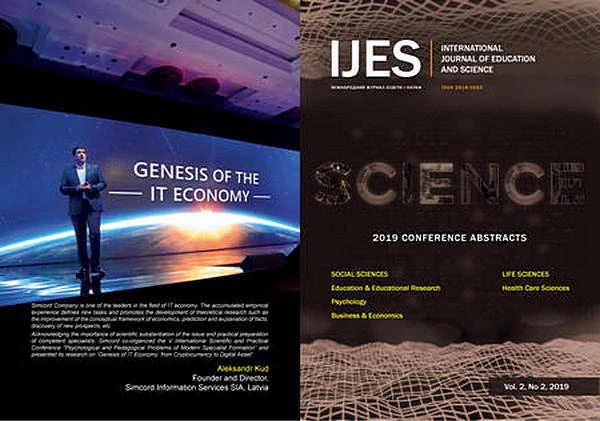
Pypenko I. S., Kud А. А. Genesis of IT Economy: from Cryptocurrency to Digital Asset |
56 |
|
|
LIFE SCIENCES
|
57 |
|
|
Health Care Sciences
|
||
|
Boyko V. V., Avdosyev Yu. V., Sochnieva A. L., Mazorchuk M. S., Yevtushenko D. O. How Long Should Biliary Decompression Last in Patients with Common Bile Duct Diseases with the Help of Antegrade Endobiliary Interventions? (in Ukrainian) |
58 |
|
|
Desiatniuk L. B., Chernysh K. A. Use of the Internet in the Formation of the Creative Personality of a Specialist in the Medical Industry (in Ukrainian) |
59 |
|
|
Iarmak T. V. The Practice of Hand Hygiene in Health Care Facilities is a Guarantee of the Patients’ and Healthcare Workers’ Safety and Health (in Ukrainian) |
60 |
|
|
Karabayev M. K., Ergashev E. A. Effect of Sodium Chloride on Morphology Self-Organization of Saliva During Their Dehydratation |
61 |
|
|
Minukhin D. V., Klimova E. M., Yevtushenko D. O. Electrophysiological Efficiency of Surgical Treatment of Patients with Generalized Myasthenia Gravis |
62 |
|
|
Muryzina O. Yu. Formation of Professional Collaborative Relations in Medical Postgraduate Practical Courses on Cardiopulmonary Resuscitation (in Ukrainian) |
63 |
|
|
Parafeynick Т. G. The Role of Interactive Methods in the Teaching of Infectology in the Training of Nursing Specialists (in Ukrainian) |
64 |
|
|
Shevchenko A. N., Polikov H. O. Instrumental Diagnostics in Patients with the Development of Necrobiotic Processes in the Intestinal Wall |
65 |
|
|
Stadnik A. V. Medical-Psychological Support for Military-Man of National Guard of Ukraine in Conditions of Hybrid Warfare |
66 |
|
|
Yechalov V. V., Gorbuntsov V. V., Sedinkin V. A. The Quality of the Test Tasks Is the Basis of the Objectivity of the Licensed Integrated Exam (in Ukrainian) |
67 |
|
|
REVIEWS
|
68 | |
|
Yermachenko V. Ye. Article Review “Substantiation of the Term “Digital Asset”: Economic and Legal Aspects”, author Kud A. А. |
69 | |
| Dmitrenko T. O. Monograph Review “Professional Training of Future Specialists of the Social Sphere to Prevent Maladjustment of Pupils”, author Kostina V. V. (in Ukrainian) |
70 | |